
Want more helpful tips on writing? Sign up for my free newsletter!
Journalists delete dozens of press releases each day. Dozens! I only write about a small fraction of the releases that pop up in my inbox.
So how do you get a journalist to write about your book? Keep in mind that my experience is in newspaper and online journalism, and things might work slightly differently for other types of media. But follow these rules, and you’re bound to get more media attention for your book.
Here’s how to create a press release that will catch the eye of a journalist:
Make it newsy. I don’t give a hoot that you just published your first book. Unless you’re Snooki and I’m a tabloid, it’s highly unlikely that I’m going to write a story about you and your book.
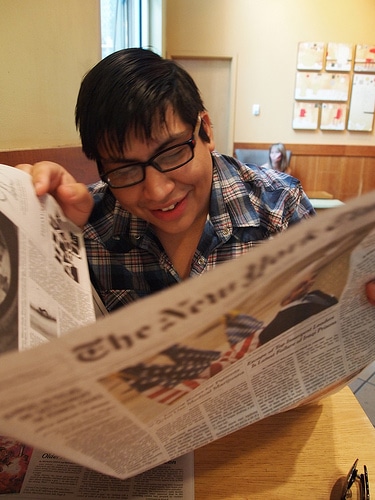
Pitch yourself well, and hey, it could happen.
What I care about is breaking news. So it’s up to you to find a way to make your book release sound newsy. The best way to do this is to present yourself as a source on a newsy topic or identify a trend that you’re qualified to speak about. Give the journalist reason to interview you, and hopefully when he quotes you, he’ll mention your book.
For example, no publication (well, other than The New York Times book review and Oprah Magazine, of course) is going to write about my book, Please Send Pants. What they might write about or discuss on television or radio is the trend of taking a career break to travel or women traveling alone. And guess who would be the perfect source for those stories? Me! That’s how I’d pitch myself in a release.
(Yes, this is easier with a nonfiction book, but I think you can accomplish it for most fiction, too.)
Target, target, target. Don’t spam every journalist and her mother with your press release, hoping it will stick. Find publications that write about what your newsy topic, figure out which journalist writes those stories, and pitch that specific journalist.
Yes, this takes time and effort and detective work, both to figure out who that person is and to find their e-mail address. It often takes more work than writing the actual release. But it significantly increases your chances of getting covered. Guess what’s likely to happen to your press release if you send it to the general news desk at your dream publication? (Unless you’re Snooki.) Nobody will notice it. If you send it to the journalist who covers that beat, even if he’s not ready to write about your topic at that very moment, he might think of you as a source down the road.
Cater to each journalist you pitch. Like with a cover letter, your pitch will be far more effective if you cater it to the needs of whoever you send it to. You can quickly blast an entire list of journalists with your press release, but you’ll be more likely to get coverage if you make that release relevant for each individual journalist. I’m not talking about rewriting the release a dozen times, just tweaking it.
Here’s a good example: A week or so ago, a school released a study about how standing tall makes us act more in charge. If the public-relations professional had pitched it to me like that in an e-mail, I probably would’ve tossed it out like all the other press releases that clogged my inbox that day. Instead, she told me why job seekers — my target audience — would care: because they’re more likely to succeed in an interview if they stand or sit up straight. I liked that practical angle, and ended up writing about it.
Write the journalist a personal note. After you paste the press release into the e-mail, write a personal note at the top. Introduce yourself and tell me — in three sentences, not three paragraphs — why you’re sending me the release and why I should care.
This is when it pays to do the legwork yourself, rather than hire a publicist. Because if the note is from the actual source, so long as that person is cogent and brief, I pay more attention than if someone else writes to me on behalf of that person. Because in general, I don’t like working with publicists. It makes extra work for me, because I have to go through them to get to the person I want to talk to. It forces me to take a risk on the actual source; I have no idea whether they know how to string together a sentence, I only know the publicist can string together a sentence. Also, public-relations folks tend to want a conference call, rather than simply helping me set up an interview with the source, which is annoying for a bunch of reasons I won’t go into here. (Because I’ve ranted enough.) What I’m saying is, if you know how to promote your book yourself, the pitch is better off coming from you.
In that short personal note, address me by name, and I’ll probably read it all the way through. Which means I’m more likely to consider your pitch than if I just skimmed the release. Because when a releases lacks a personal note, I’d guess I spend less than 10 seconds looking it over to decide whether I’m interested. Yup, you put all that work into the press release, and I delete it in 10 seconds. And that’s exactly why it’s crucial to…
Get to the point. Fast. If not in the title, then in the first sentence. Tell me right away what you have to offer. And keep your press release short, no longer than a few paragraphs. Because if I’m only spending 10 seconds judging what you have to offer, you only want your best content in that pitch.
What do you mean, you can’t cut your pitch down to a few paragraphs? You’re a writer. Try harder.
Display your contact information prominently. Give me an e-mail (that’s how I usually make my first contact), phone number and website. If you’re pitching an event, I love releases that lay out all the information at the top, like an invitation:
What: Your one-line pitch
When: Date and time
Where: Your venue
Offer an e-version. No, this does not mean a PDF, as one poor PR professional thought when I asked him for one earlier this month. I’m talking about an electronic version of the release, you know, on that new-age thing called a website. Why? Because even if I’m not interested in writing a story about your pitch, I might want to share it with my networks on Facebook and Twitter, which usually works in your favor. And I’ll only do that if you make it easy for me.
Know the power of local. If you’re from San Diego, you’re far more likely to get coverage from San Diego media than from television or radio or print media in upstate New York. That’s because readers like to read about people who are like them, and reporters are tasked with finding those people.
The local angle is so powerful that it might even trump the newsy angle, meaning your local media might want to write about you and your book just because you have some connection to that area. Don’t forget to mention your local ties in your press release when you’re targeting local media. Same for pitching alumni publications.
Have you had luck reaching out to media? What worked for you? What aspects of book promotion do you find most difficult?
Photo credit: Flickr’s Orijinal.
Alexis, thanks for sharing these tips on press releases. I’ll be writing several over the coming weeks, and I appreciate your advice. I’ll be taking the main release and then targeting it to specific publications in specific cities.
I really like what you say about putting the press release on my website.
Glad to help! Hope your promotion is successful!
Thanks! Great info. I’ll pass this on to our authors.
I’ve never thought about getting press releases out before. Thanks for sharing. Even though I’m extremely far from this point in my publishing journey, I’ll be bookmarking this post for when I’m ready. And I can’t help but notice that many of these tips will come in handy come query letter time, so double thanks.
Excellent post, Alexis! It’s so interesting to read these tips from a journalists perspective, since most of what I know comes from working in PR. I was especially interested in where you said you don’t like working with publicists because it’s sometimes difficult to get to the source, among other reasons; I’d love to chat with you about these some other time! I’m always looking for ways that I can improve working with the media.
As for writing a targeted pitch, it’s sad that this even needs to be a legitimate tip…but people STILL send untargeted pitches. So bad. I get them on my book review blog and every time I get one, it encourages me even more to take the time to personalize each pitch because it really does make me feel good when I get a pitch that was actually targeted to me!
Hey Jess — Happy to talk. I’ve worked with some fabulous publicists too, of course. But in general I’d prefer the pitch come from the author/expert. I wonder why more publicists don’t guide the author through the process — help her target, write the release, etc. — and then let the author pitch directly. Best of both worlds! Kind of like a PR coach 🙂
Thanks Alexis, this is incredibly useful for anyone writing a press release, not just authors spreading the word about their books. I’ll be using your tips for an upcoming event I’m organizing here in Beijing!
Alexis,
This is great. Thanks so much. I will be utilizing these tips soon, as my memoir comes out this year.
Thanks so much for sharing this info! Press releases are something that I’ve found “mystifying”, so this was extremely helpful!
I found your site through GoodReads and am glad I took the time to check your info. You gave a great explanation and I appreciate the help on press release writing.
Good luck with your endeavors,
Dawn Kunda
This is so good. Thanks for taking the time to share your wisdom once again.
How funny that I’ve published an eBook on writing press releases and showing people how to do it right so its accepted, and even where to submit them, but I’ve never written a press release for my own book (unrelated to press releases, just a teen fiction) that I have written! Derrr.. I’ll have to get on that.
Thanks for this great post, I have been looking for something that lay it out just like you did on how to write an effective pr.
Thanks for giving me a kick in the right direction. I think like a retired scientist, which is what I am, but I’m going to have to think like a journalist to succeed in marketing my book. It doesn’t matter that I’ve already coauthored three serious reference books by major outlets, because those publishing houses marketed the books. I am on my own with a self-published book. Nothing is guaranteed.
I thought it would be a good idea to do an experiment, i.e., to test the water, so I gave away a few paperback copies to local libraries. The catalog librarian at Baxter County Library indexed “Legalized Killing” at Dewey Decimal 345.93, which put it on the shelf between John Grisham’s “The Innocent Man” and a thick reference book, “The Dred Scott Case.” The library has two copies of Grisham’s book, and they stay checked out most of the time. Mine has been out at the rate of about once monthly. “The Dred Scott Case” has never been checked out. So I know my book will fly if the right journalist calls attention to it (perhaps someone like Mary Grace?). People need to know about the issue it deals with, because there is a new danger out there.
Hi Alexis!
Thanks so much for this fantastic post.
I’m a young adult fantasy writer, and from your tips I was able to figure out a way to make my novel “newsy”.
I can’t wait to publish then really get to use this tip!
*Smiley Faces*
– Cheyenne Lynnae
http://www.cheyennelynnae.
Woohoo! Thank you for this awesome post. My debut is coming out next month and I’ve gotta send an editor my release, had no clue how to write one so I googled it and voila, your site. 🙂
I appreciate this bunches. Thanks!
Awesome article. I love it. You were straight to the point and blunt, as well. Press releases aren’t supposed to be difficult, such as a brain surgery. It’s more like a walk in the park with pit bull chasing you – you have to be proactive when pitching your story. Know what direction you want to go before doing so.
Follow me on Twitter: @Courage2Believe
many thanks! this is very helpful. I have just released my third book and never has a press release written before, I figured it is time. I have created a website for the book and a blog, but still trying to figure out the best place to place a release on the site http://www.hunyuanfertility.com any tips appreciated.
I’ve spent more than an hour and a half researching how to do a press release for my children’s book God’s Greatest Miracle. Your tips give me THE MOST confidence because you are “one of them”— who responds, or not, to the p. r. Thank you, Alexis. I am so grateful!
You’re welcome, Margaret! Good luck!
Thank you so much for the useful information! I have one question though; if you have a published a book on Kindle or CreateSpace, do you include the link to the book in the press release?
Yes, that’s smart!
Thanks for this informative post, Alexis! One question: I published my book in February 2013, but never did a press release. Do you think it’s too late now?
Thanks so much!
Mary
It’s never too late if you have a great angle/hook!
Thanks Alexis.
That helps. I have to rewrite my publishers press release.
Clear, precise, plain talk information! I will soon release Ministry or Mayhem? a full length non-fiction ministry help but I love writing more than the process we must use to get the word out! Thanks for making it easy! Great tips!
Check out “Faith-Amid-Chaos-Volume-1” on Amazon!
Thanks Alexis you have the most helpful information on press release for a book. I really appreciate your site.
This is a great post. I just finished my press release the other day and was searching the web to see how other people were writing theirs. I may tweak mine a little bit but am pretty happy with how mine came out. I just published my first book A Mom’s Point Of View: Beginning Adulthood. The book is meant as a guide for young adults moving out on their own for the first time.
Thank you for any other great article. Where else could anyone get that
kind of information in such an ideal means of writing?
I’ve a presentation next week, and I’m on the look for such info.
Hi Alexis, thanks for posting this article. Great information for those of us who know we can do this ourselves but are also clueless on what to do. 🙂
Wonderful blog! Do you have any suggestions for aspiring
writers? I’m hoping to start my own website soon but I’m a little lost
on everything. Would you suggest starting with a free platform like WordPress or go for
a paid option? There are so many choices out there that I’m totally overwhelmed ..
Any suggestions? Cheers!